 Softwavz
L
O
A
D
I
N
G
Softwavz


Two to three hours a day, per clinician, spent typing what they already know.
Ask a clinician what they like least about their software and the answer is almost never the clinical part. It is the documentation. A fifteen-minute note after a twenty-minute consultation is not unusual, and it is unpaid, so it lands in the evening.
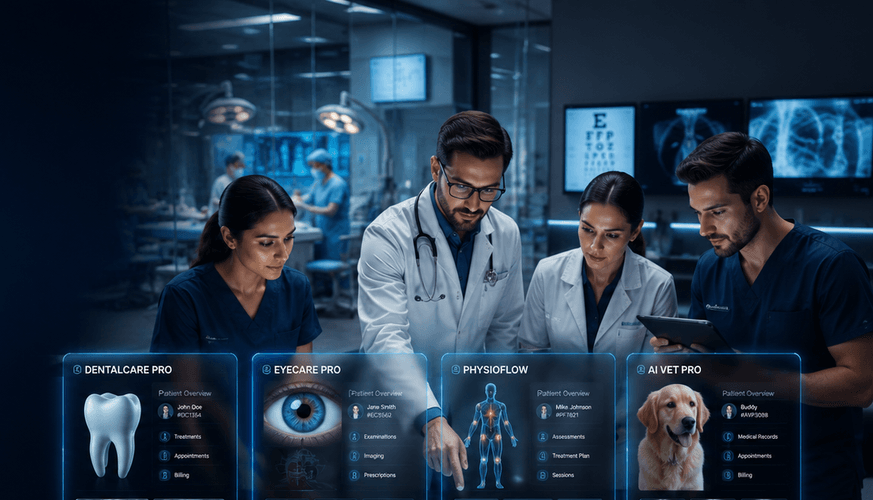
When we built the charting in DentalCare Pro, PhysioFlow, EyeCare Pro and AI Vet Pro, we started by watching where the fifteen minutes actually goes. Very little of it is thinking.
Patient identifiers, the tooth or region already selected on screen, the medication already on file, the referring practitioner already in the record. In most systems these are typed again into a free-text box because the note is a text field rather than a structured record.
The first and largest saving is simply not asking twice. If the system knows it, the note should already contain it, and the clinician should be correcting rather than composing.
Generic EMR templates are the reason so many practices abandon them. A physiotherapy assessment, a refraction and a periodontal chart have almost nothing in common, and a template that tries to serve all three serves none.
Specialty-native templates cover the ninety per cent case in a few taps and leave free text for the exception. That is the difference between a template that saves time and one that gets skipped.
Dictation only helps if the output is a filled-in record rather than a transcript. A wall of spoken text still has to be reorganised into the fields, which is the work you were trying to avoid.
In AI Vet Pro the consultation is spoken naturally and comes back as a structured note — the subjective, objective, assessment and plan sections populated, ready to review. The clinician reads and corrects. That is a meaningfully different task to writing.
Anything generated must be reviewable, editable, and recorded as accepted by a named person at a time. That is not a nicety in clinical work — it is the difference between a defensible record and a liability.
It also builds trust. Clinicians accept assistance they can overrule far more readily than automation that presents itself as finished.
Cutting a fifteen-minute note to under three returns roughly two to three hours a day per clinician. Practices spend that differently — some add appointments, some end the day on time, some finally do the recalls nobody had time for.
The point is that it was never clinical time. It was administrative time wearing clinical clothing, and it is the cheapest hour in the building to get back.
Specialty templates and voice-to-note capture work this way in DentalCare Pro, PhysioFlow and AI Vet Pro. In each of them the clinician reviews and signs the note before it is saved, and the system records who changed what.
We build the systems behind this — nine of them, running in production. Book a 45-minute walkthrough and we will show you how it works against your own workflow, or tell you honestly if you do not need it yet.


