 Softwavz
L
O
A
D
I
N
G
Softwavz



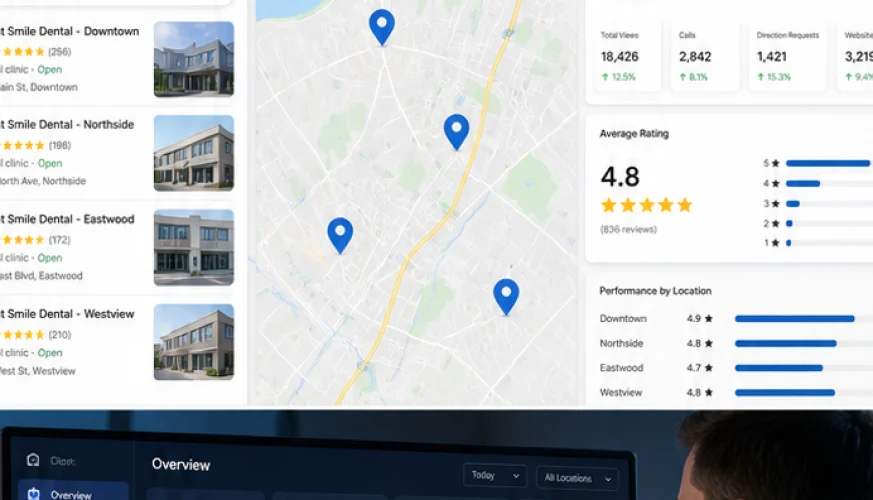
Your branches are competing with each other, and the search engine cannot tell them apart.
A single-site clinic doing local SEO has a simple job. A group with six sites in one city has a harder one, and the usual failure is not a competitor — it is the group's own branches splitting the signals between them until none of them ranks.
The fixes are unglamorous and they work in a fairly reliable order.
Every branch needs its own page. Not a template with the town name swapped, which search engines have been discounting for years, but a page with that branch's clinicians, hours, parking, accessibility, the treatments actually offered there, and directions people would genuinely use.
If two branch pages are interchangeable apart from the address, expect one of them to be ignored. The test is whether a patient choosing between your sites would find the page useful.
This is dull and it is the highest-yield thing on the list. Every directory, profile, footer and citation should agree exactly — the same suite number, the same abbreviation, the same phone format.
Groups accumulate variants over years of ad-hoc listings. Fix the canonical version first, then work outward through the places that copied it.
A Google Business Profile per branch, each with correct hours including holidays, real photographs of that location, and the services offered there. Profiles are a ranking factor and also the first thing a patient sees, so an unclaimed or stale one costs twice.
Reviews accrue per profile too, which is another reason not to run a group from one shared listing.
Review volume and recency both matter, and neither improves by asking occasionally. It works when it is part of the appointment flow — a message after a completed visit, sent automatically, going to the profile for the branch attended.
Respond to them, including the critical ones. A measured reply to a poor review reassures the next reader more than the review discourages them.
Mark up each location page so the address, opening hours, specialties and accepted payments are machine-readable rather than inferred from the layout. It will not lift you past a stronger competitor on its own, but it removes ambiguity — and ambiguity is what causes a search engine to hedge between your branches.
Local SEO is slower than paid search. Meaningful movement typically takes three to six months, and anyone promising faster is either buying risk or guessing.
The compensation is that it compounds. Paid traffic stops the day the budget stops; a branch page that ranks keeps producing appointments for years, and it is the cheapest patient acquisition most practices have.
This is the work we do under Digital Marketing, and the branch-level structure it depends on — separate locations, per-branch hours, clinicians and reviews — is native to DentalCare Pro and PhysioFlow.
We build the systems behind this — nine of them, running in production. Book a 45-minute walkthrough and we will show you how it works against your own workflow, or tell you honestly if you do not need it yet.


