 Softwavz
L
O
A
D
I
N
G
Softwavz



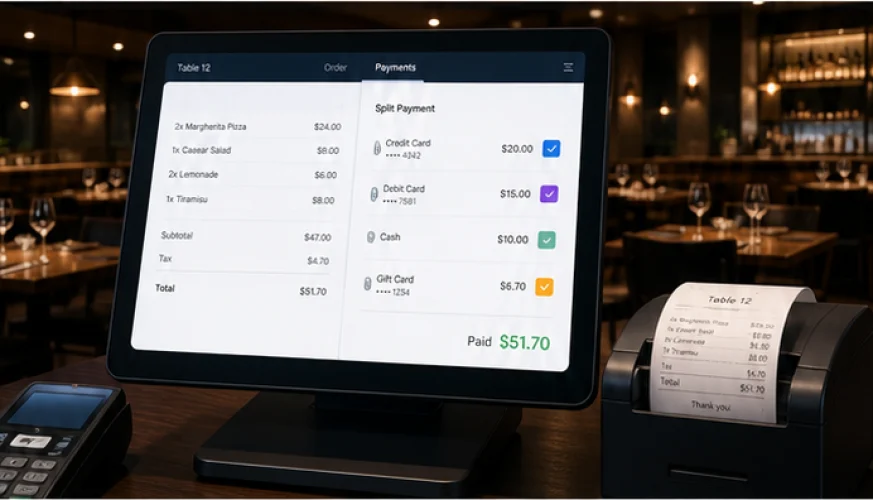
If a system cannot split by item, it was designed around the table, not the diner.
Ask a restaurant which part of their POS they hate and you will hear about splitting the bill. Six people, one shared starter, two of them leaving early, one paying for a colleague. It is Friday, there is a queue at the till, and the software wants the table settled as a single amount.
This is not a missing feature. It is a modelling decision made early, and it is the fastest way to judge a system before you buy it.
Cheap systems attach the order to the table. The table has a total; payment reduces the total. Splitting is then approximated — divide by four, or take a fixed amount off — and anything more precise means voiding and re-entering the whole order.
A system built around items attaches each line to the order, and payment to a set of lines. Splitting is then just selecting which lines this person is paying for. Shared items divide across the payers who claim them. Nothing needs re-entering, because nothing was assumed about who pays.
You cannot retrofit the second design onto the first. That is why this particular limitation never gets fixed in an update.
The other half of the problem is the kitchen. If splitting a bill re-fires tickets, or reorders a KOT, or makes a course appear twice on the pass, staff will avoid the feature entirely and go back to paper.
Billing changes have to be invisible to the kitchen display. The food was already made; who pays for it is a front-of-house question. Any system that couples the two will cause an argument during service.
Take any demo and run this: six covers, one shared platter, two diners leave and pay for their own items plus a third of the platter, one pays by card and one by UPI, then the remaining four settle together with a discount on one main. Add a late round of drinks after the first payment.
That is a normal Friday, not an edge case. Most systems fail somewhere in the middle of it, and where they fail tells you exactly how the data is modelled underneath.
Once diners order from their own phones, the assumption that a table is one bill collapses completely. Everyone has their own line items from the start, and they expect to pay for them.
That is the model Restaurant Pro — was built around: items belong to the diner who ordered them, the table is just how they are grouped, and payment is applied to lines rather than to a total. Splitting stops being a feature and becomes the default behaviour.
Not much per bill — a minute of till time, a small rounding loss, an occasional discount to end an argument. Multiplied across a service, across every weekend, it is real money and a queue at the counter when you are trying to turn tables.
It is worth an extra hour of evaluation before choosing, because it is not something you can fix later without changing systems.
Restaurant Pro was built around the item-based model described above, so splitting a bill any way a table asks for is ordinary behaviour rather than a workaround.
We build the systems behind this — nine of them, running in production. Book a 45-minute walkthrough and we will show you how it works against your own workflow, or tell you honestly if you do not need it yet.


