 Softwavz
L
O
A
D
I
N
G
Softwavz



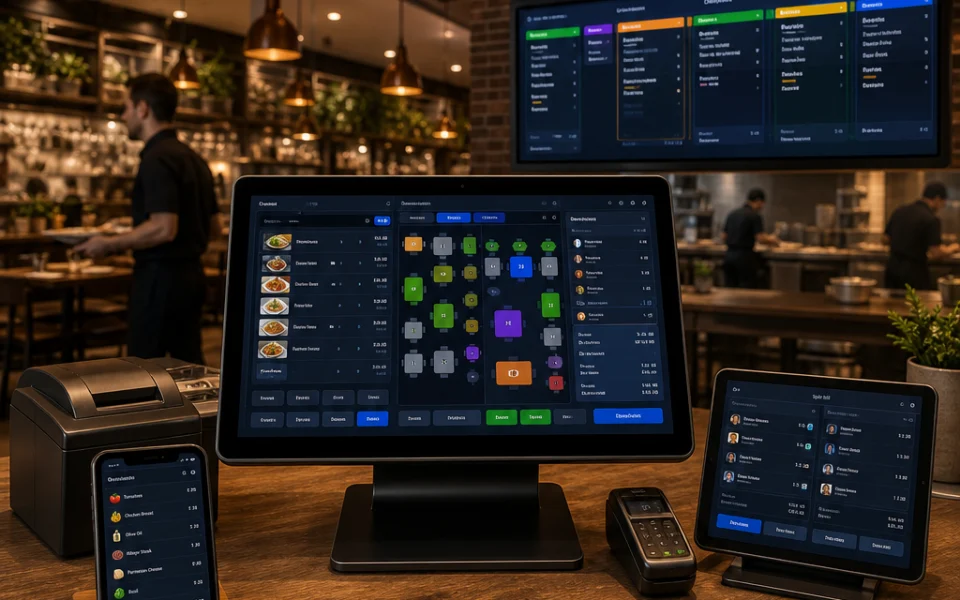
A POS is judged in the ninety minutes when every table turns at once, not in a demo on a quiet Tuesday.
Most restaurants run five disconnected tools between an order being placed and money reaching the bank — billing here, kitchen tickets on paper, reservations in a notebook, delivery on an aggregator dashboard, reconciliation in a spreadsheet at midnight.
This is one Friday service through a single system. Every step is a capability described on the Restaurant Pro product page.
Reservations are not notes in a book; a booking changes the live status of the table. As guests arrive, auto table linking attaches the reservation to the table without anyone retyping it.
The floor plan shows areas and sections with live table status. A party of nine is seated across two tables that are merged into one session, to be settled together later.
Table nine scans the QR on their table and orders from their own phones — the full menu with images, variations and live pricing, in the guest's own language. A takeaway order comes in at the counter. Two delivery orders arrive, one from the restaurant's own commission-free storefront and one from an aggregator.
All of them land in the same order list. The kitchen and the reports do not care where an order came from, which is the entire point: one pipeline means one number at day-end.
Orders become KOTs automatically, with no re-typing. KOT Places route each item to the station that actually makes it — a bar item does not print at the grill. One order, three printers, no confusion.
A guest taps for service and the waiter is notified instantly. When a diner changes their mind and an item is removed, the cancellation reason is captured, so wastage has an owner rather than being absorbed silently.
Table nine asks to split. Two guests left early and already paid, one is covering a colleague, and there is a shared platter in the middle.
Because items belong to the diner who ordered them and the table is only how they are grouped, payment is applied to lines rather than to a total. Part-payments and dues are tracked, several methods can settle one bill, and per-order discounts and charges apply without voiding the order and starting again.
When something does not print, the print queue and print log say why — rather than leaving a server to guess whether the kitchen ever saw it.
Payments arrive through any of ten built-in gateways plus whatever offline methods the restaurant defines. A refund carries a structured reason and is gated by role, so not everyone can issue one.
The rider fleet settles through a native iOS and Android app rather than a web page in disguise, with COD collected and reported against each executive.
Day-end is method-wise earnings, table-wise earnings, cancelled and refund reports — not a manager reconciling cash, card and COD by hand.
For a second outlet, the menu is central with per-branch pricing, roles lock down what each person sees, and reporting consolidates across every outlet. A price change is made once, not three times.
The test worth running on any system before you sign is the ordinary one: six covers, one shared platter, two diners leaving early, one paying for a friend. That is a normal Friday, not an edge case.
About this walkthrough. This describes how Restaurant Pro works, using a representative example rather than a named client. Every step corresponds to a capability documented on the Restaurant Pro page, and there are no performance figures here because those belong to individual clients rather than to the software.
Book a 45-minute walkthrough and we will open Restaurant Pro live against how your team actually works — or tell you honestly if you do not need it yet.


