 Softwavz
L
O
A
D
I
N
G
Softwavz



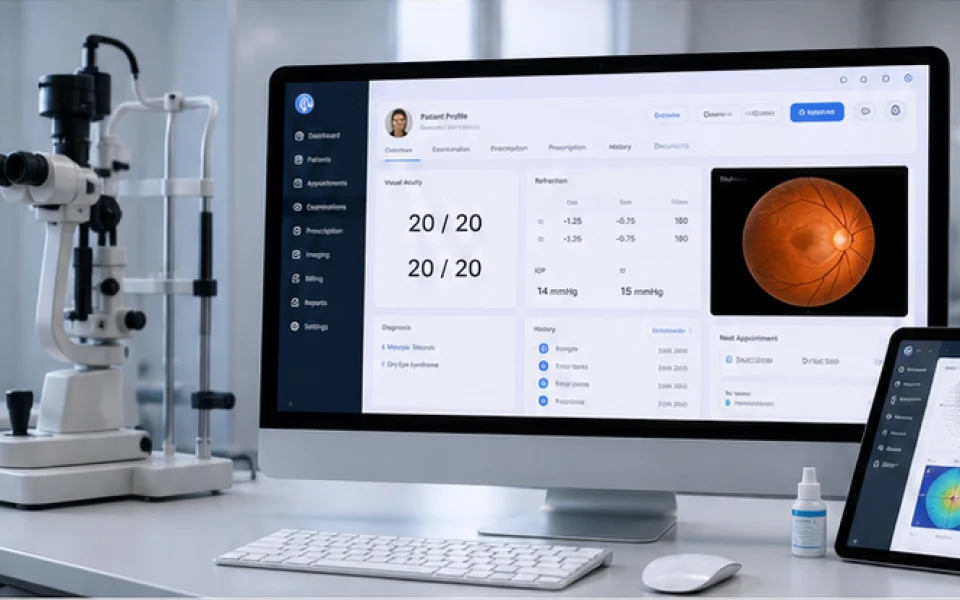
An eye hospital is really three businesses — a clinic, an operating theatre and a retail shop — and most software is only built for one of them.
The costs are familiar. Refraction cards go missing, so there is no history when the patient returns. Clinic and shop run on separate software, so revenue never quite reconciles. Glaucoma and diabetic patients drift out of follow-up, which is preventable vision loss and lost recurring revenue at the same time.
This is one patient followed from the door to the spectacle counter. Every step is a capability described on the EyeCare Pro product page.
A permanent UHID is generated for the patient and holds across every branch, so returning to a different site does not create a second identity. A token is allocated automatically and the OPD queue behaves like a queue rather than a crowd.
Demographics, insurance, structured allergies and history are captured once, and staff jump straight into the EMR from the same screen.
This is the module the doctors live in. Right eye and left eye are first-class concepts — OD and OS built in from the ground up rather than added as custom fields on a generic hospital system.
Distance and near, UCVA and BCVA in Snellen or LogMAR, SPH, CYL, Axis, ADD and PD. Every past refraction sits on one timeline, so power progression is visible at a glance instead of being reconstructed from cards.
Glaucoma risk is scored on every exam, with cup-to-disc ratio tracked over time, visual field index timings recorded, and intraocular pressure flagged when it sits above the 21 mmHg threshold. Anti-glaucoma eyedrop regimens are held against the patient rather than in a letter.
Diabetic retinopathy screening runs as its own module, with HbA1c tracked alongside retinal stage and retinal images stored per screening. A proliferative case transfers to the operating theatre list in one click.
Microaneurysms, haemorrhages and hard exudates are marked directly on the fundus image, with a severity grade from none through to PDR and a confidence score shown alongside it, so the clinician knows how much weight to give it.
The product page states the boundary plainly and it belongs here too: the AI assists the ophthalmologist by highlighting findings and suggesting a grade. It never replaces the diagnosis, and every case is clinician-confirmed. What it changes is throughput in high-volume screening camps and the support available to junior staff — not who is accountable.
IOL power is calculated at the chair-side from axial length, K1, K2 and the A-constant using the standard SRK-T formulation. Adjust a K-value and the power updates live — no separate calculator, no paper worksheet.
The result saves straight to the surgical record the OT team works from. Room, surgeon and slot are booked with pre-operative parameters already attached, and cases move from scheduled to in progress to done without a whiteboard.
The prescription the doctor wrote becomes the bill at the counter. SPH, CYL, Axis and ADD for both eyes plus PD dispatch to the optical POS in one click, with nothing re-typed between the refraction room and the shop.
Billing is GST-ready and thermal-printer friendly. Inventory covers frames, lenses and medicines with unique SKU enforcement, batch numbers, expiry dates and supplier details — which is the difference between stock control and a spreadsheet that is always slightly wrong.
Seven decision panels, each figure a live database record rather than a static chart: glaucoma caseload and uncontrolled IOP alerts, OCT and fundus counts, dispensing status, unpaid shop invoices, frames ready for pickup.
Change the date filter and the whole screen re-answers — today, last week, last month, or any range. Each staff role sees only their own module group, so the audit question of who opened which record has an answer.
The clinic, the theatre and the shop are one patient's journey, not three systems. Most of what an eye hospital loses is lost in the handoffs between them.
About this walkthrough. This describes how EyeCare Pro works, using a representative example rather than a named client. Every step corresponds to a capability documented on the EyeCare Pro page, and there are no performance figures here because those belong to individual clients rather than to the software.
Book a 45-minute walkthrough and we will open EyeCare Pro live against how your team actually works — or tell you honestly if you do not need it yet.


